
Hate & Non-Human Listening, an Introduction
In January 2026, WIRED reported that U.S. Immigration and Customs Enforcement (ICE) has begun using Palantir’s AI tools to process public tip-line submissions. The system does not simply store or relay these reports. It processes English-language submissions, condensing them into what is called a “BLUF”—a “bottom line up front” summary that allows agents to quickly assess and prioritize cases.
Efficiency is the dominant framing as the system promises speed, clarity, and control over overwhelming volumes of information. Yet such efficiency depends on a prior reduction as expression is detached from the conditions of its articulation and reconstituted as data. In this form, listening no longer risks misunderstanding, it eliminates it.
Nor does this infrastructure operate in isolation. It relies on distributed participation in which listening is recast as vigilance. A recent ICE public X (Twitter) post encouraged residents to report “suspicious activity,” assuring them that doing so would make their communities safer.
The language is familiar, even reassuring. But it depends on a prior act of interpretation: that certain voices, presences, or behaviors are already legible as threat. Listening here becomes pre-classification—identifying danger in advance and acting on that identification as if it were already known. Rather than an isolated case, this development signals a broader transformation in how immigration and enforcement are governed. As legal and policy analyses increasingly note, artificial intelligence is becoming “one of the fundamental operating tools of policing,” deployed across domains ranging from speech and text analysis to risk assessment and document verification. Systems such as USCIS’s Evidence Classifier, which tags and prioritizes key documents within case files, and platforms like ImmigrationOS, which aggregate data across agencies to guide enforcement decisions, do not simply process information—they reorganize it. What matters is not only what is said, but whether it aligns—across time, across records, across bureaucratic expectations. Listening becomes continuous and anticipatory, oriented toward detecting inconsistency, deviation, and risk before any claim can be made or contested.

A very different narrative circulates alongside these developments. A recent BBC article suggested that AI chatbots can function as unusually “good listeners”—patient, nonjudgmental, even compassionate. Users describe these systems as offering space for reflection, sometimes preferring them to human interlocutors. Yet what is at work is not attention or relation, but pattern recognition trained to simulate understanding. Taken together, these examples reveal a shared transformation. Across both enforcement systems and everyday interaction, listening is increasingly detached from sensation, exposure, and accountability, becoming a process of extraction and classification rather than relation. As Dorothy Santos argues in her account of speech AI, machines do not simply assist human listening; they assume its position, becoming “the listeners to our sonic landscapes” while also acting as the capturers, surveyors, and documenters of our utterances. What follows from this shift is not just a change in who listens, but in what listening is. Listening no longer names an encounter between subjects; it describes a technical operation distributed across infrastructures that register, store, and act on sound without ever hearing it.
This shift is what I call “nonhuman listening.”
Nonhuman listening names both an infrastructural condition and a set of practices through which listening is reorganized as a technical operation. It describes a mode of perception distributed across systems that capture, process, and act on sound without exposure to it as experience, as well as the procedures—classification, ranking, prediction—through which sound is rendered actionable in advance. At stake is not simply the emergence of new technologies, but a reorganization of what listening has long been understood to do. Listening unfolds across thresholds of perception, attention, and care, shaped by what can be sensed, cultivated, or ignored. From its earliest formulations, it has been understood not as passive reception but as an ethically charged capacity. Aristotle’s distinction between akousis (hearing) and akroasis (listening) marks this divide, reserving listening for forms of attention capable of judgment and response. In this sense, listening has always named both openness and control: a posture of receptivity toward others and a way of organizing the world.
Nonhuman listening amplifies an older logic: not all voices are heard, and not all forms of speech register as meaning and listening does not begin from neutrality. Norms organize it in advance, determining what registers as signal, who gets to hear, and whose speech counts as intelligible. Meaning and noise do not inhere in sound itself; they emerge through historically sedimented expectations about voice, difference, and belonging.
Sound studies has long challenged the assumption that listening inherently connects or humanizes. Listening does not operate as an immediate or intimate relation; it relies on frameworks that precondition perception. Jonathan Sterne shows that claims about sonic immediacy function less as empirical truths than as ideological formations—narratives that naturalize particular social arrangements while obscuring how listening renders some forms of speech legible and others unintelligible. Listening does not simply receive the world—it organizes it.
At the same time, theoretical and experimental approaches foreground the instability of this organization. Voices do not exist as stable entities prior to their mediation; they “show up as real,” as Matt Rahaim writes, through specific practices and infrastructures that render them intelligible, contested, or indeterminate. Jean-Luc Nancy conceptualizes listening as resonance, emphasizing exposure—the possibility that listening might unsettle the subject—while also underscoring that such openness never distributes evenly. John Cage and Pauline Oliveros treat listening as a disciplined practice that requires cultivation and can fail as easily as it attunes. Listening is not given; it is trained.

Across these accounts, listening operates within regimes of power. Jacques Attali locates listening within governance, where institutions determine what can be heard, what must be silenced, and what becomes disposable. Trauma and memory studies intensify these stakes. Henry Greenspan shows that listening to testimony never occurs as a singular or sufficient act, and that extractive modes of attention can reproduce violence rather than alleviate it. Ralina L. Joseph’s concept of radical listening reframes listening as an ethical orientation—one that demands accountability to power, difference, and fatigue, and that attends to how speakers wish to be heard. As she writes, “the easiest way to refuse to listen is to keep talking.”
Taken together, these accounts point to a more difficult claim: listening is not simply uneven—it is directional. It can orient toward exposure and relation, or toward certainty and verification. When listening turns toward certainty, it no longer encounters speech as an address. It apprehends it in advance while certain voices register not as claims or appeals, but as warnings or threats.
Such orientation has precedents that are neither abstract nor metaphorical. During the 1937 Parsley Massacre, Dominican soldiers used pronunciation as a test of belonging. Suspected Haitians were asked to say the word perejil (parsley); those whose speech did not conform to expected phonetic norms were identified as foreign and often killed. Listening here did not register meaning or intent. It functioned as classification—reducing speech to a signal of difference and acting on that difference as if it were already known.
This logic persists in contemporary enforcement practices, albeit in different registers. Recent encounters with U.S. immigration agents reveal how accent continues to operate as a proxy for suspicion and a trigger for intervention. In multiple reported incidents, individuals have been stopped or detained and asked to account for their citizenship on the basis of how they sound: “Because of your accent,” one agent stated when asked to justify the demand for documentation . In another case, an agent explicitly linked auditory difference to disbelief, telling a driver, “I can hear you don’t have the same accent as me,” before repeatedly questioning where he was born.
In these moments, listening again operates as pre-classification. Accent is not heard as variation, history, or movement, but as evidence—an audible marker of non-belonging that precedes and justifies further scrutiny. What is at stake is not mishearing, but a mode of listening trained to stabilize difference as risk. Speech becomes legible only insofar as it confirms or disrupts an already established expectation of who belongs.
Early analyses of digital surveillance anticipated a more radical transformation than they could yet fully name. Writing in 2014, Robin James identified an emerging “acousmatic” condition in which listening detaches from any identifiable listener and disperses across systems of data capture and analysis. The 2013 Snowden disclosures make clear that this shift was not theoretical but already operational. State surveillance had moved from targeted interception to total capture, amassing communications indiscriminately and deriving “suspicion” only after the fact, as a pattern extracted from within the dataset itself. Listening no longer responds to a known object; it produces the object it claims to detect. What registers as “suspicious” does not precede analysis but materializes through algorithmic filtering, where signal and noise become effects of the system’s design rather than properties of the world. Under these conditions, listening ceases to function as a sensory or interpretive act and instead operates as an infrastructural logic of sorting, ranking, and preemption. Contemporary platforms extend and normalize this logic. They do not hear sound; they process it, rendering it actionable without ever encountering it as experience.

The essays collected in this series extend this transformation across distinct but interconnected domains, tracing how nonhuman listening operates through sound, speech, and platformed media. Across these accounts, listening no longer secures meaning or relation; it becomes a site of contestation, where sound is mobilized, processed, and weaponized within systems that privilege circulation, recognition, and response over truth. Next week, Olga Zaitseva-Herz situates these dynamics within the context of digital warfare, where AI-generated voices, deepfakes, and synthetic media circulate as instruments of psychological manipulation, designed to provoke affective responses that travel faster than verification.
Contemporary speech technologies make this continuity visible at the level of language itself. As work in the Racial Bias in Speech AI series shows, particularly as Michelle Pfeifer demonstrates, speech technologies do not simply fail to recognize certain speakers; they formalize assumptions about what counts as intelligible language in the first place. In these systems, the voice is not encountered as expression but as input—something to be parsed, categorized, and aligned with existing datasets. When AI systems encounter African American Vernacular English—especially emergent idioms shaped by Black and queer communities—language is flattened into surface definitions, stripped of cultural grounding, or flagged as inappropriate. Speech is not heard as situated expressions; it is processed as deviation from an unmarked norm.
What emerges is a form of hostile listening: not the misrecognition of a human listener, but a condition in which recognition is structurally focused. Racialized language becomes perpetually at risk–mistrusted or excluded–not because it fails to communicate but because it exceeds the parameters through which the system can register meaning. Hate here is not expressive or intentional; it is procedural, embedded in the standards that determine what can be heard as language at all.
In this sense, the problem is not that listening has been replaced. It is that it continues—without exposure, without relation, without consequence for those who perform it. What appears as neutrality is the absence of risk. What appears as efficiency is the removal of encounters. Under these conditions, harm does not need to be spoken. It is heard into being in advance—stabilized as signal, confirmed as threat, and acted upon before it can be contested. The question that remains is not whether machines can learn to listen better. It is whether we can still recognize listening once it no longer requires us at all.
—
Kathryn Agnes Huether is a Postdoctoral Research Associate in Antisemitism Studies at UCLA’s Initiative to Study Hate and the Alan D. Leve Center for Jewish Studies. She earned her PhD in musicology with a minor in cultural studies from the University of Minnesota (2021) and holds a second master’s in religious studies from the University of Colorado Boulder. She has held visiting appointments at Bowdoin College and Vanderbilt University and was the 2021–2022 Mandel Center Postdoctoral Fellow at the United States Holocaust Memorial Museum.
Her research examines how sound mediates Holocaust memory, antisemitism, racial violence, and contemporary politics. She has published in Sound Studies and Yuval, has forthcoming work in the Journal of the Society for American Music and Music and Politics. She is a member of the Holocaust Educational Foundation of Northwestern University’s (HEFNU) Virtual Speakers Bureau and has been an invited educator at two of its regional institutes, and is current editor of ISH’s public-facing blog. Her first book, Sounding Hate: Sonic Politics in the Age of Platforms and AI, is in progress. Her second, Sounding the Holocaust in Film, is a forthcoming teaching compendium that brings together key concepts in Holocaust studies with methods from film music and sound studies.
—
Series Icon designed by Alex Calovi
—

REWIND! . . .If you liked this post, you may also dig:
Your Voice is (Not) Your Passport—Michelle Pfeifer
“Hey Google, Talk Like Issa”: Black Voiced Digital Assistants and the Reshaping of Racial Labor–Golden Owens
Beyond the Every Day: Vocal Potential in AI Mediated Communication –Amina Abbas-Nazari
Voice as Ecology: Voice Donation, Materiality, Identity–Steph Ceraso
Share this:

The Absurdity and Authoritarianism of Now: My Chemical Romance’s The Black Parade Resonates Queerly, Anew
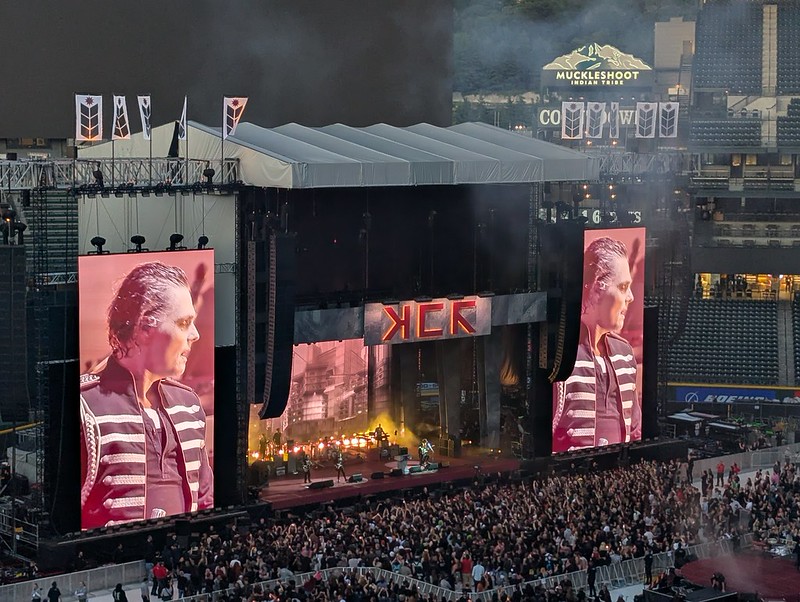
My Chemical Romance fans are speculating about new music after the band wiped their X account clean and wrapped up the Latin America leg of their tour this month. Whether another album is on the way or not, MCR’s magnum opus – The Black Parade – continues to endure two decades later. The sound now resonates through MCR’s commentary on fascism, critiquing the nation while holding the crowd accountable for our participation or passivity.
As the band tours The Black Parade for its 20th anniversary, the members have rejected nostalgia in favor of a new storyline, playing alter-ego characters who have been conditioned to perform for a dictator. The plot, slightly shifting night to night, encourages fans to follow along.
In the first run of the tour, each concert paused midway for an “election.” Four hooded figures walked out to the center stage. Nearby, an army official watched. Singer Gerard Way asked the audience to vote: Support these candidates or reject them? Each person in the crowd had a sign. One side: YEA. The other side: NAY.
“Now we need to hear you,” Way says. The audience roars, jeering and cheering.
No matter the spectators’ will, the result is the same: execution.
The warped election – and the sound of The Black Parade – reflects the absurdism of authoritarianism. Here is a democracy that ends in death, regardless of how you vote. Viewers log into livestreams to watch the fanfare repeat.
MCR’s commentary echoes the ramping authoritarianism and upheaval in the United States:
- The Supreme Court cleared the way for immigration agents to use race as a reason to stop and check someone’s citizenship documents. Daily ICE arrests reached a decade high last year. 2025 also marked the deadliest year for people in ICE custody in two decades.
- Protests have swept the nation, with outrage further increasing after federal agents killed two Minneapolis demonstrators this January.
- Cuts and changes to Medicaid and SNAP are on their way. The longest government shutdown also ended without extending subsidies for health care.
- The Epstein files were released, showing ties between powerful leaders and sex offender Jeffrey Epstein.
- The Department of Governmental Efficiency, named after an outdated Internet meme (DOGE), has resulted in the elimination of at least 290,000 jobs.
- The U.S. withdrew from the Paris Agreement and World Health Organization. The country also pulled out of 66 international organizations.
- Trump continues to enact steep tariffs after a Supreme Court ruling against his policy.
- Layoffs soared past 1.1 million job cuts in 2025, the highest since 2020’s COVID-19 shutdown.
This list represents a fraction of stories and executive orders in 2025; a “flood the zone” strategy overwhelmed the news cycle. Despite censorship efforts – such as the federal defunding of NPR and PBS – much of this information is available to us at the click of a button. State-sanctioned propaganda even encourages the spectacle. Just take a look at footage of ICE raids on the WhiteHouse’s TikTok account, set to songs and images of pop stars:
Yet fatigue and fearmongering keep many complacent; looming economic crises also draw our attention and time. I do not mean to diminish people’s efforts of resistance. But I am interested in the way technology has expanded our potential to witness violence, without ever requiring us to act – as well as the power of entertainment to distract.
So I turn back to MCR’s spectacle, which twists and mirrors this descent into fascism. Up against the tour’s faux-executions, the boos and the cheers of the crowd collapse into a cacophony. I locate the sound of our times within these screams, where dissent seems to go unheard and melds into the chorus of support.
The Black Parade is full of these bombastic wails, but the most intense of them are in “Mama,” a song that balloons into an extended eight-minute performance in the Long Live the Black Parade Tour. Within “Mama,” I try to make some sense of these screams, finding queer resonance with the present moment.
With my analysis, I ask: How might we hold fascist figures to account without squirming out of our own role in the daily exchange of authoritarianism? I argue My Chemical Romance’s 2025-2026 performance of “Mama” highlights structures of violence but also criticizes our participation within them.
In “Mama,” the indulgence of sin is contagious. It’s loud. It’s repeated: “Mama, we all go to hell.” This refrain, set to a polka beat, creates an abject intimacy around our shared fate. Queer listeners have interpreted this song as an angry anthem against the rejection we face from our families and dogmatic religion. For those of us who have heard, “You’re going to hell,” the response, “We all go to hell,” serves as a relief. Verses like “You should’ve raised a baby girl, I should’ve been a better son” have been reclaimed by transgender fans.
Other fans have taken issue with these interpretations, arguing queer attachments distract from the “true” meaning of the song. Indeed, “Mama” tells the story of a soldier writing from the trenches of war, while his mother judges him from afar. But I argue that by placing a queer reading in tandem with the canonical narrative, generative meanings emerge. Queer theory provides tools to understand the role of the mother here. Mama is the title of the song. Mama is pervasive. Mama is mean. Mama is on his mind. But she is also almost entirely absent, avoiding accountability for her son’s violence and instead blaming him: “She said, ‘You ain’t no son of mine.’”
The soldier finds that the trenches are not just his domain, but also his mama’s: “Mama, we’re all full of lies…And right now, they’re building a coffin your size.” His plea to his mother helps us wonder: What about the culture that birthed this violence? In this metaphor, critiquing the mother extends to critiquing the nation.
At the climax of the song, these sentiments come through screams: 30 seconds of an extended, “AHHHHHH” and a crying out of, “Mama, Mama, Mama.” In these wails, I find a soldier begging to share responsibility with his motherland, even as he contends with his own role in the violence. The cries puncture the polka, demonstrating “Mama” is not a celebration, after all.
Mama only sings one line back, through the voice of theater icon Liza Minnelli: “And if you would call me a sweetheart/I’d maybe then sing you a song.” Minnelli’s voice connects the song’s sound to her role in Cabaret, a musical which mixes together queer aesthetics and indulgent decadence with a foreboding rise of fascism. This allusion to Cabaret, as well as the tour performance, serve as a reminder: pleasure and entertainment does not always equal resistance.
In the extended version of “Mama” on tour, these lines are sung by an opera singer, whose voice, too, serves the dictator. Preceding her performance, the song briefly opens up a space for resistance. A new section of the song, debuted on the tour, includes the lyrics:
A dagger, a dagger
Please fetch me a dagger
A tool for our treasonous needs…
With tears in our eyes we collapse on the crosses
And said death be the son of us all
This war is the son of us all.
Even as Gerard Way’s character plots treason against the dictator, these new lyrics make clear: this “death” and “war” is “the son of us all.” Though we might want to pin fascism on one figure, many Americans have participated in the creation of this “death/war.” There are fatal consequences for our collective actions – or our passivity.
Ultimately, the dramatics of this song, delivered like a sinister weapon, critique violence, while ironically trapping us in its pleasures. If prayer is crying out to our father who art in heaven, “Mama” is yelling back at our mother to bring her to where she belongs: the hell in which we both exist. Given the stakes of our political moment, I argue we need to scream louder, with purpose and strategy, against our motherland.
—
Featured Image: “My Chemical Romance Live at T-Mobile Park 6/11/25,” Image by Flickr User Laura Smith CC BY-ND 4.0
—
Max Lubbers (he/she) is a first-year PhD student in the American Studies and Ethnicity department at the University of Southern California. His research centers on transgender affects and sounds. Max earned a bachelor’s degree in Journalism and Gender and Sexuality Studies from Northwestern University, with a senior thesis on butch affect. She previously worked as a journalist, with pieces in Chicago’s NPR station, Colorado Public Radio, and Windy City Times.
—

REWIND!…If you liked this post, check out:
The Sounds of Equality: Reciting Resilience, Singing Revolutions–Mukesh Kulriya
Vocal Anguish, Disinformation, and the Politics of Eurovision 2016–Maria Sonevytsky
“To Unprotect and Subserve:” King Britt Samples the Sonic Archive of Police Violence —Alex Werth
Share this:


Current Top Posts





April 2021

January 2020

November 2019

October 2019

August 2019

April 2014

November 2017

March 2015

December 2017

October 2015
 Sounding Out!
Recent Comments